
Tucson homeowners have access to some of the best decorative concrete ideas in the Southwest, thanks to a climate that lets flatwork cure properly and stay intact year-round. Stamping, staining, overlays, and engraving can turn a plain gray slab into a surface that looks like flagstone, wood plank, or polished marble. The trick is picking the right technique for your specific space, budget, and maintenance tolerance. Below are five proven approaches that local contractors install regularly across patios, driveways, pool decks, and entryways throughout the Tucson metro area.
Stamped Concrete Patterns for Tucson Patios and Driveways
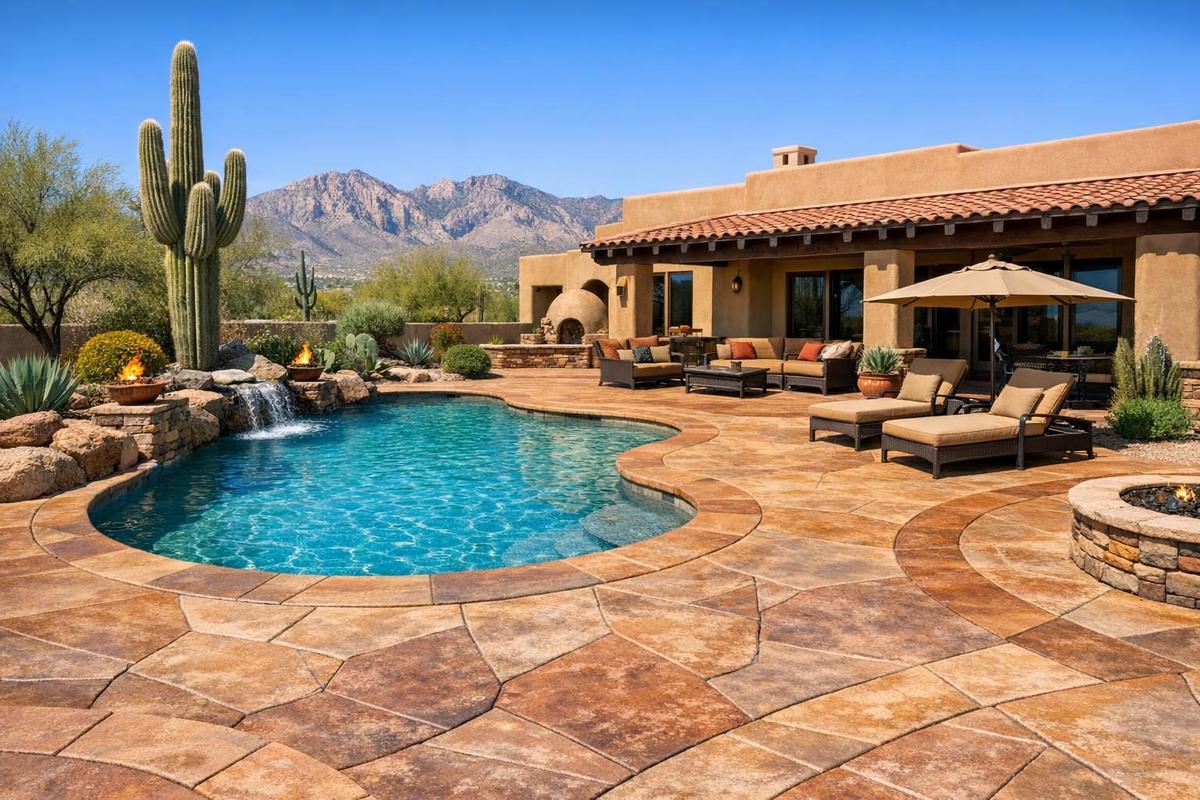
Stamped concrete replicates the look of natural stone, brick, or wood by pressing textured molds into freshly poured slabs. A typical 400 sq ft patio costs between $8 and $18 per square foot installed, which is roughly half the price of real flagstone. One thing most guides skip: the release agent color matters as much as the base color. A charcoal release over a tan base creates shadow lines that mimic real grout joints, while a matching release looks flat and artificial.
Popular stamp patterns in Tucson include Ashlar slate, herringbone brick, and random stone. Each works best in a different context.
- Ashlar slate suits modern homes with clean lines and pairs well with neutral color hardeners.
- Herringbone brick fits traditional Southwestern architecture and looks natural alongside well-designed driveways.
- Random stone mimics a dry-laid flagstone patio and hides minor cracking better than uniform patterns.
Tucson’s monsoon season puts stamped surfaces to the test. Proper sealing every 2 to 3 years prevents moisture from penetrating the surface and causing spalling. Solvent-based sealers hold up better than water-based options in direct desert sun, though they cost about 30% more per gallon. For a deeper look at stamping and staining techniques, check our detailed guide.
Stained Concrete Floors and Surfaces
Staining transforms existing slabs without the cost of a full tear-out and repour. Acid stains react chemically with the calcium hydroxide in cured slabs, creating translucent, variegated color that won’t peel or flake. Water-based stains offer more color choices (over 30 standard shades) but sit on the surface rather than penetrating it, so they need a quality topcoat.
The biggest mistake I see on stain projects is skipping the test patch. Every slab absorbs stain differently depending on its age, mix design, and prior treatments. A 2 ft x 2 ft sample in an inconspicuous corner takes 20 minutes and prevents a $3,000 surprise. If you’re considering this approach for interior floors, stained flooring has some distinct advantages worth reviewing.
Acid stain works particularly well on Tucson pool decks and covered patios where the mottled finish hides minor discoloration from hard water and leaf tannins. Two coats of stain followed by a slip-resistant sealer create a surface that handles bare feet, pool splash, and monsoon rain without issue.
Concrete Overlay Systems for Existing Surfaces
An overlay is a thin cementitious layer (typically 1/8 to 1/4 inch thick) applied over structurally sound existing slabs. It gives you a fresh canvas without demolition. Polymer-modified overlays bond well to old surfaces and accept stamps, stains, or hand-carved textures.
Three situations where overlays make the most sense:
- The existing slab is structurally solid but cosmetically damaged with surface cracks, staining, or outdated coloring.
- You want a wood-look floor finish without removing the original pour.
- The surface needs a level correction of less than half an inch before installing a final finish.
Overlays do have limits. They won’t fix settlement cracks or structural failure. If a slab has heaved more than half an inch or has active settling, the overlay will mirror those problems within a season. A qualified installer will check for movement before recommending this route.
Epoxy and Polyaspartic Coatings for Garage Floors
Epoxy coatings, a type of resinous floor system, protect garage floors and workshop surfaces from oil stains, tire marks, and chemical spills. A two-coat epoxy system with vinyl flake broadcast typically costs $3 to $7 per square foot for professional installation. Polyaspartic coatings cure faster (same-day return to service vs. 72 hours for standard epoxy) and resist UV yellowing, which matters for Tucson garages that catch direct afternoon sun.
| Feature | Epoxy | Polyaspartic |
|---|---|---|
| Cure time | 48 to 72 hours | 6 to 8 hours |
| UV resistance | Moderate (can yellow) | High (stays clear) |
| Cost per sq ft | $3 to $5 | $5 to $8 |
| Durability | 10 to 15 years | 15 to 20 years |
Surface preparation drives 90% of coating success. Diamond grinding or shot blasting opens the pore structure so the resin bonds mechanically. Acid etching alone produces weak adhesion and leads to peeling within 18 months. For a full breakdown of coating types and their pros and cons, we have a separate comparison.
Engraved and Scored Concrete Designs
Engraving uses specialized rotary tools to cut patterns, borders, or custom graphics directly into cured slabs. Unlike stamping, engraving works on both new and existing surfaces. Scoring creates shallow saw-cut lines that form geometric patterns, tile grids, or faux stone layouts.
Engraving paired with stain is one of the most cost-effective decorative concrete ideas for entryways and interior floors. A contractor can engrave a compass rose, a custom border, or a repeating tile pattern into an existing slab, then stain each section a different color. The result looks like inlaid stone at a fraction of the material cost.
Maintenance is straightforward. Engraved lines collect less dirt than stamped texture joints, so a pressure washer on a low setting cleans them in minutes. Resealing every 3 to 4 years keeps the stain color vibrant and prevents moisture absorption. To understand the basics of what qualifies as decorative work, our overview page covers the fundamentals.
How to Choose the Right Decorative Finish for Your Property
Picking a finish comes down to three factors: the condition of the existing surface, your visual preference, and your long-term maintenance commitment. Here is a quick decision framework.
- New pour with full design control: stamped patterns or integral color.
- Existing slab in good structural shape: staining, engraving, or an overlay.
- Garage or utility space: epoxy or polyaspartic coating.
- Pool deck or high-moisture area: textured overlay with slip-resistant sealer.
Start by getting quotes from at least two licensed installers in Tucson who specialize in the finish you want. Ask each one to show photos of local projects completed at least 3 years ago, because that is when quality differences become visible. Request a written warranty that covers adhesion failure and color fading. The fastest way to narrow your options is to bring a photo of the look you want and let the contractor recommend the technique that achieves it within your budget.
Frequently Asked Questions About Decorative Concrete Ideas
How long does stamped or stained concrete last in Tucson’s climate?
Stamped and stained surfaces typically last 20 to 30 years with proper sealing every 2 to 3 years. Tucson’s dry heat is actually easier on sealers than humid climates, though UV exposure means you should use a UV-stable sealer to prevent yellowing.
Can you apply a decorative finish over an old cracked slab?
Surface cracks under 1/8 inch wide can usually be filled and covered with an overlay or coating. Structural cracks caused by settling or heaving need repair before any finish goes on, because the movement will telegraph through the new surface within months.
What is the cheapest decorative option for a patio?
Acid staining an existing slab is usually the lowest-cost option at $2 to $4 per square foot for professional application. It works only on bare or previously unsealed slabs. Stamped overlays run $6 to $12 per square foot and give you more design flexibility.
Do decorative finishes make surfaces slippery when wet?
Smooth stained or sealed surfaces can be slick around pools and entryways. Adding a non-slip aggregate to the final sealer coat or choosing a textured stamp pattern solves this. Most Tucson contractors include slip-resistance treatment as standard for pool decks and walkways.
How do I maintain colored or coated surfaces?
Routine care involves sweeping debris and rinsing with a garden hose monthly. Reseal stamped or stained surfaces every 2 to 3 years and recoat epoxy or polyaspartic floors every 5 to 7 years. Avoid using deicing salts, which are rarely needed in Tucson but can damage sealers if applied.