
Commercial concrete Tucson projects live or die on two things: the right mix design and a crew that understands the desert. A parking lot that cracks in its second monsoon season, a warehouse floor that dusts under forklift traffic, a foundation that heaves on expansive soil. These are not bad-luck accidents. They trace back to decisions made before the first truck ever backs up to the form. This page walks through what this work in Tucson actually involves, what it costs, and how to tell a capable contractor from one who will leave you patching in five years.
- What Counts as Commercial Concrete in Tucson?
- Commercial Concrete Services We Handle
- How Tucson's Desert Climate Shapes Every Pour
- Concrete Specs That Matter on Commercial Jobs
- Our Pour Process, Step by Step
- What Commercial Concrete Costs in Tucson
- How to Choose a Commercial Concrete Contractor in Tucson
- Frequently Asked Questions About Commercial Concrete in Tucson
- How much does commercial concrete cost in Tucson?
- What is the difference between residential and commercial concrete?
- How thick should a commercial concrete slab be?
- What PSI is used for commercial concrete?
- How long before a new commercial slab can be used?
- Do commercial concrete projects in Tucson need permits?
What Counts as Commercial Concrete in Tucson?
Commercial concrete is structural and flatwork poured for business, industrial, and public use rather than single-family homes. Think parking lots, tilt-up walls, footings for a steel building, loading docks, sidewalks that meet accessibility code, and slabs rated to carry heavy equipment. The line between residential and commercial is not just size. It is engineering. A backyard patio needs to look good and drain. A distribution center floor has to hold a loaded forklift at 3,000 pounds per wheel, day after day, for twenty years.
That difference shows up in the details. Commercial pours usually carry higher compressive strength, more reinforcement, engineered joint spacing, and inspection requirements tied to permits. In Tucson and the surrounding Pima County, most large slabs also have to answer to the Sonoran Desert, the arid high-heat region that stresses concrete in ways a mild climate never would.
Commercial Concrete Services We Handle
Most business properties need more than one type of pour, so we work across the full range. Here is what shows up most often on job sites around the metro area:
- Parking lots and drive lanes: reinforced pavement with proper slope for monsoon drainage and ADA-compliant striping layouts.
- Structural slabs and footings: engineered foundations for retail, office, warehouse, and light industrial buildings.
- Tilt-up construction: casting wall panels on site and lifting them into place, a fast method common on large single-story buildings.
- Warehouse and industrial floors: high-strength, flat, joint-controlled slabs finished for forklift and rack loads. See our commercial concrete flooring options for coatings and finishes.
- Sidewalks, curbs, and ADA ramps: public-facing flatwork built to accessibility standards and city inspection.
- Loading docks and equipment pads: thick, heavily reinforced sections that take impact and point loads.
- Repair and resurfacing: crack stitching, slab lifting, and overlays. When a surface is worth saving, our concrete repair crew restores it instead of tearing it out.
How Tucson’s Desert Climate Shapes Every Pour
Heat is the first enemy. When ground temperatures push past 100 degrees, fresh concrete loses water too fast, and rapid moisture loss causes surface cracking and a weak top layer. We schedule large pours for early morning, use retarders in the mix, and start wet curing right away. In my experience, the jobs that fail in Tucson almost always skipped the curing step to save a day.
Then come the monsoons. July and August dump hard, fast rain onto sites that were bone dry a week earlier. Without correct slope and control joints, water pools, seeps, and refreezes the crack cycle every year. Expansive clay soils in parts of the valley swell when wet and shrink when dry, which is why a foundation here needs real geotechnical attention, not a guess. If an existing building is already moving, our foundation repair team stabilizes it before new work goes in.
Concrete Specs That Matter on Commercial Jobs
Compressive strength, measured in pounds per square inch (PSI), tells you how much load a mix can carry before it fails. This work runs stronger than residential across the board. These are the typical minimums we design to, following American Concrete Institute (ACI) guidance for structural work:
| Application | Typical PSI | Typical Thickness |
|---|---|---|
| Sidewalks and walkways | 3,000 to 3,500 | 4 inches |
| Parking lots and drive lanes | 4,000 | 6 to 8 inches |
| Warehouse and industrial floors | 4,000 to 5,000 | 6 inches |
| Loading docks and equipment pads | 5,000 | 8 inches or more |
| Footings and foundations | 3,000 to 4,000 | Per engineer |
Reinforcement matters as much as strength. Rebar and welded wire mesh hold a slab together after it cracks, because concrete will crack. Control joints, cut at engineered spacing, tell those cracks where to go so they stay straight and hidden instead of spider-webbing across a new floor. Skip the joints and you get a mess. Space them right and the slab looks clean for decades.
Our Pour Process, Step by Step
Every project follows the same disciplined sequence. Rushing any step is where problems start.
- Site evaluation and estimate. We assess soil, drainage, access, and load needs, then price the scope. This sets the mix design and reinforcement plan.
- Permits and layout. We pull the required permits and stake the layout so grades and dimensions match the plan before excavation.
- Excavation and base prep. Crews grade, compact the subbase, and set the aggregate base, because a slab is only as stable as what sits under it.
- Forming and reinforcement. We build forms to the engineered elevations and place rebar or mesh at the correct depth and spacing.
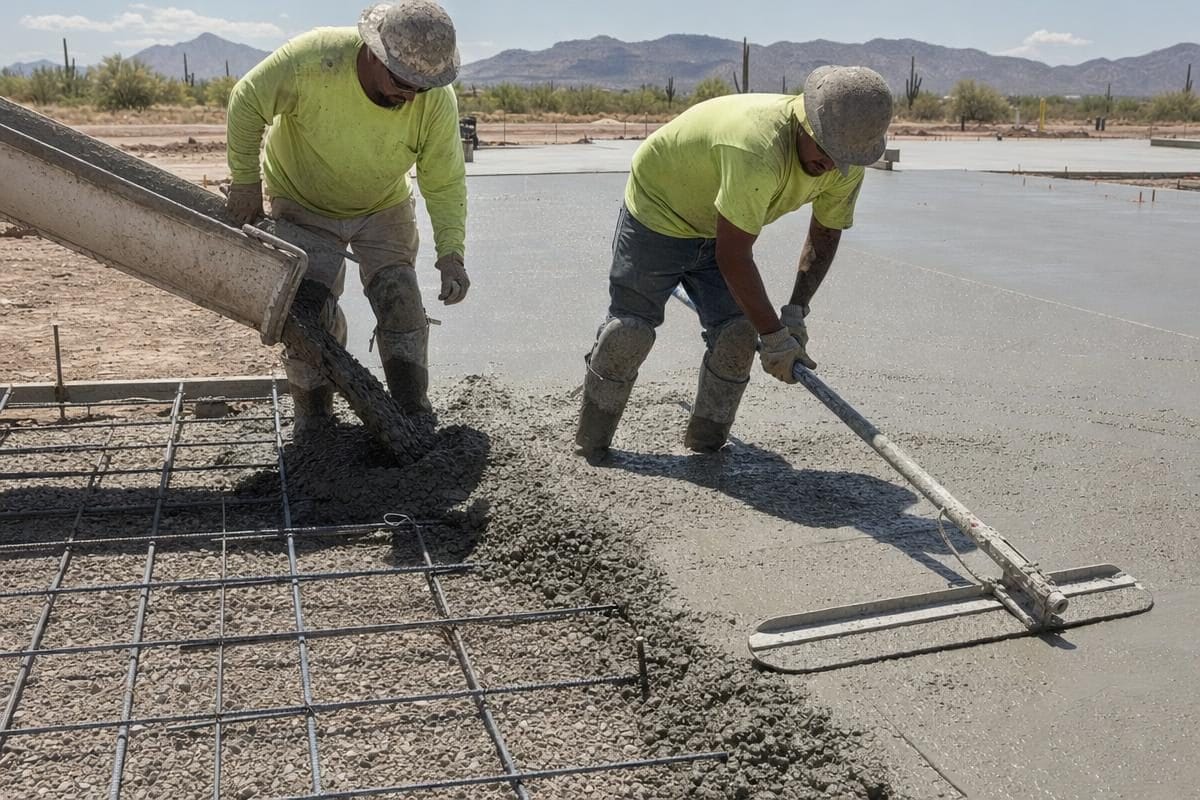
- Placement and finishing. Ready-mix concrete is placed, screeded, and finished to the specified texture, whether broom finish for traction or a hard trowel for interior floors.
- Curing and joint cutting. We cure the surface to control moisture loss and saw control joints on schedule. This protects the strength you paid for.
What Commercial Concrete Costs in Tucson
Commercial work in Tucson typically runs $6 to $15 per square foot installed, and the spread comes down to strength, reinforcement, thickness, and finish. A plain 4-inch sidewalk sits at the low end. A reinforced 8-inch loading dock or a polished interior floor sits at the top. Site conditions move the number too, since poor soil, tight access, and demolition of an old surface all add labor.
| Project Type | Typical Installed Cost (per sq ft) |
|---|---|
| Standard commercial flatwork | $6 to $9 |
| Reinforced structural slab | $8 to $13 |
| Parking lot paving | $5 to $9 |
| Polished or coated interior floor | $8 to $15 |
Those are planning ranges, not quotes. For a number tied to your actual square footage and spec, run the figures through our Tucson concrete pricing calculator or call for a site visit. This matters because a real estimate accounts for soil and access, which generic per-foot pricing never captures.
How to Choose a Commercial Concrete Contractor in Tucson
The contractor you hire matters more than the mix on the truck. Anyone can order 4,000 PSI. Far fewer know how to place and cure it correctly in 105-degree heat. Here is what separates a commercial concrete Tucson crew you can trust from one you cannot:
- Licensing and insurance: an Arizona ROC license, general liability, and workers’ compensation, verified in writing.
- Project references: completed lots, slabs, and buildings you can drive past, not just backyard patios.
- Permit and inspection experience: a team that has worked with Pima County and City of Tucson inspectors before.
- A written scope: mix design, thickness, reinforcement, joint plan, and curing method spelled out, so you know what you are buying.
One mistake I see repeatedly is owners choosing on price alone, then paying twice when a cheap slab fails inspection or cracks within a year. As a full-service concrete contractor in Tucson, our team has poured across the valley for decades, on projects of every size, and we put the plan in writing before we pour.
Ready to move forward? Start by getting a written estimate that lists PSI, thickness, and reinforcement for your site. Then compare on scope, not just the bottom line. For dependable commercial concrete Tucson property owners rely on, call Concrete Tucson at (520) 600-5080 for a free site evaluation, and schedule early if your pour needs to beat monsoon season.
Frequently Asked Questions About Commercial Concrete in Tucson
How much does commercial concrete cost in Tucson?
This work in Tucson typically costs $6 to $15 per square foot installed. Standard flatwork sits near the low end, while reinforced structural slabs and polished floors reach the top. Soil, access, and demolition needs move the final price.
What is the difference between residential and commercial concrete?
This work uses higher compressive strength, more reinforcement, engineered joint spacing, and permit-based inspection. Residential work prioritizes appearance and lighter loads. A driveway holds a car, while a commercial slab may carry loaded trucks and racking for decades.
How thick should a commercial concrete slab be?
Most such slabs run 6 inches thick, with loading docks and heavy equipment pads at 8 inches or more. Sidewalks stay near 4 inches. A structural engineer sets the final thickness based on the loads and soil at your site.
What PSI is used for commercial concrete?
These mixes usually call for 4,000 to 5,000 PSI, following American Concrete Institute guidance. Parking lots typically use 4,000 PSI, while loading docks and industrial floors often require 5,000 PSI for durability under heavy point loads.
How long before a new commercial slab can be used?
Foot traffic is usually fine after 24 to 48 hours, but concrete reaches roughly 70 percent of its strength in 7 days and full design strength near 28 days. Heavy vehicle and rack loads should wait until the slab has properly cured.
Do commercial concrete projects in Tucson need permits?
Yes. Most such pours require permits and inspection through the City of Tucson or Pima County, especially structural slabs, foundations, and ADA-related flatwork. A contractor experienced with local inspectors keeps the project on schedule and up to code.