
Concrete Tucson pours, replaces, and refinishes driveways for homes and businesses across Tucson, AZ. A driveway made of concrete is a reinforced slab poured over a compacted base, and in the desert it has to survive 115-degree afternoons, summer monsoon downpours, and constant UV. This page covers what goes into a concrete driveway Tucson heat and storms won’t wreck: the services we offer, how the finishes compare, what a correct pour looks like, and how to get a free estimate.
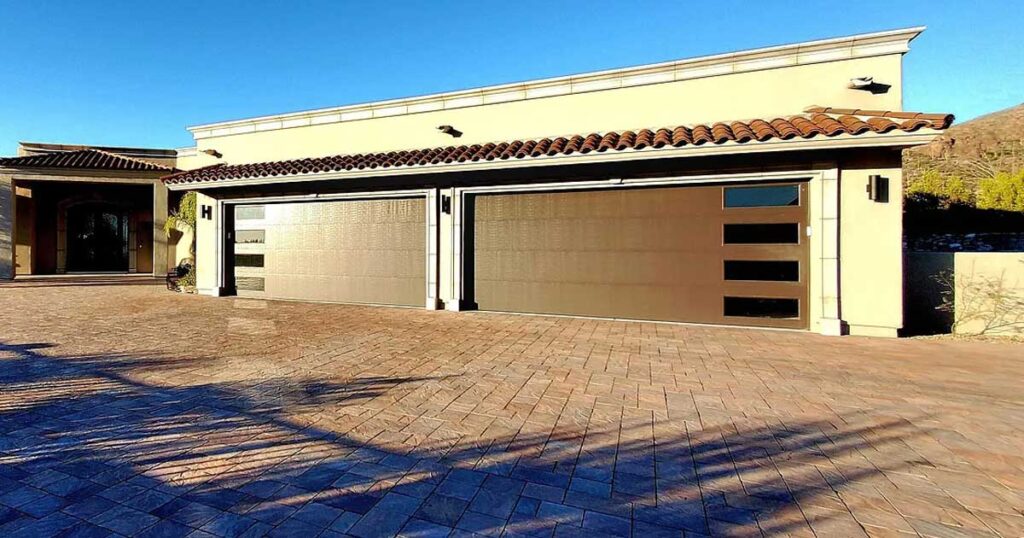
- Concrete Driveway Tucson Services We Offer
- How It Compares to Asphalt, Pavers, and Gravel
- Decorative Finishes and Design Options
- What Quality Concrete Installation Requires
- Tucson's Trusted Concrete Contractor
- Contact Us Today for a Free Estimate
- Frequently Asked Questions
- Is a concrete driveway worth the money?
- Should I use 4 inch or 6 inch concrete for a driveway?
- What are the disadvantages of concrete driveways?
- How do I choose a driveway contractor in Tucson?
- What types of services do you offer?
- How long does a properly installed surface last?
- Do you offer paving services in Tucson?
Concrete Driveway Tucson Services We Offer
Every job falls into one of five categories, and the right one depends on what’s already in the ground and how it has held up.
- New driveway installation: grading, base, forms, reinforcement, and the pour for new homes or lots that only had gravel or dirt.
- Tear-out and replacement: removal of cracked, sunken, or heaved slabs (or old asphalt) and a fresh pour on a rebuilt base.
- Extensions and widening: an extra parking pad, RV apron, or side strip tied into the existing slab with doweled joints so the two sections move together.
- Leveling and resurfacing: for slabs that are structurally sound but uneven or worn on top, which costs far less than full removal.
- Decorative finishes: stamped, stained, and exposed aggregate surfaces, plus overlays that refresh a plain gray slab.
If more than a quarter of the slab is cracked through, sinking at the edges, or lifting near tree roots, replacement usually beats patching. Surface scaling and hairline cracks on a level slab are a resurfacing job instead.
How It Compares to Asphalt, Pavers, and Gravel
Concrete costs more upfront than asphalt or gravel, but it holds its shape in desert heat and needs the least ongoing work. Here is how the four common surfaces behave in this climate:
| Surface | Summer heat | Monsoon runoff | Typical upkeep |
|---|---|---|---|
| Concrete slab | Stays firm, reflects more sun | Sheds water if sloped correctly | Seal every few years |
| Asphalt | Softens, shows tire scuffs | Edges erode and crumble | Reseal every few years |
| Pavers | Stays firm | Joint sand washes out | Re-sand, pull weeds, reset shifted units |
| Gravel | No softening, but dusty | Washes out and ruts | Regrade and top off |
Pavers look appealing at first, but they shift on the clay-heavy soils found across the Tucson area, and weeds push up through the joints. Asphalt needs resealing on a regular schedule and softens under direct sun. For a closer look at the trade-offs, see the comparison of concrete driveways versus pavers and the driveway cost breakdown for asphalt and cement slabs, which lists per-square-foot ranges.
With the right mix design and proper curing, a durable slab can last 30 years or more with minimal repair work. That durability is the real payoff: over a 20 to 30 year window, total cost stays well below repeated asphalt overlays or paver resets.
Decorative Finishes and Design Options
A plain broom finish is the most affordable and the most slip-resistant choice. The other options trade a bit of cost or upkeep for appearance:
- Stamped concrete: mimics stone, brick, or wood grain at a fraction of the cost. Desert dust settles into deep texture lines, so simpler, shallower patterns age better here.
- Stained finishes: acid-based stains react with the cement for mottled, earthy tones; water-based stains give more even, predictable color.
- Exposed aggregate: the top layer of paste is washed off to reveal the stone in the mix, leaving a textured surface with good grip and less visible dust.
- Overlays and resurfacing: a thin bonded layer that refreshes a worn but sound slab without tearing it out.
The right finish depends on traffic load, sun exposure, and how much upkeep you’ll accept. Dark stains absorb more heat, and a glossy sealer can turn slick during a monsoon storm, so a non-slip additive in the sealer is worth asking about on sloped surfaces. Decorative concrete patterns go well beyond these four, and these driveway design tips cover borders, color pairing, and layout.
What Quality Concrete Installation Requires
Subgrade preparation decides how a slab performs more than any other step. If the base is not compacted correctly and graded for drainage, even the best mix will crack within a few years. A sound pour follows this order:
- Site check: measure the area, note slope and where roof and street runoff flows, and probe for caliche or expansive clay.
- Excavation and base: remove the old surface, then lay four to six inches of compacted aggregate, graded away from the house and garage.
- Forms and reinforcement: set forms for a slight slope toward the street, then place fiber mesh, wire mesh, or rebar sized to the load, not only at thickened edges.
- Pour and finish: place and finish the mix early in the day during summer, since hot, dry air pulls water out of the surface too fast and weakens it.
- Control joints: cut joints at proper intervals so natural shrinkage cracks form in the joint line instead of across the slab. A common rule of thumb spaces them, in feet, at two to three times the slab thickness in inches.
- Cure: keep foot traffic off for a day or two and vehicles off for at least seven days, regardless of how dry the surface looks.
The hot-weather guidance in ACI 305, published by the American Concrete Institute, explains why summer pours need early start times, shade or wind breaks, and wet or compound curing. Skipping those steps in June is how a new slab ends up with surface crazing by fall.
How Thick Should Driveways in Tucson Be?
Four inches over a compacted base is the standard for passenger cars, SUVs, and light trucks. If you park RVs, trailers, boats, or delivery trucks on it, step up to five or six inches with heavier reinforcement. Thickness alone doesn’t guarantee performance, though: subgrade, drainage, and joint spacing matter just as much. The full guide to slab thickness and PSI ratings explains how to match depth to load and soil.
Concrete Driveway Tucson Care After the Pour
Once cured, a slab needs little attention. Apply a penetrating sealer every few years to slow UV wear and oil staining, clean spills before they soak in, and keep sprinkler overspray and roof runoff from pooling along the edges, which softens the base underneath. These driveway maintenance steps go into crack sealing and cleaning in more detail.
Tucson’s Trusted Concrete Contractor
Concrete Tucson is a locally owned company that handles residential and commercial concrete work, and our team of experts works closely with every client from estimate to final cure. As a concrete contractor in Tucson, we cover more than driveways:
- Custom driveways, including leveling for existing surfaces
- Concrete patio installations for outdoor living spaces
- Concrete sidewalks, walkways, and paving for homes and commercial lots
- Coating, polished floor finishing, and resurfacing
- Repair and patching for cracked or worn areas
Pairing a new driveway with a patio, sidewalks, or other hardscaping services under one project keeps colors and textures consistent from the curb to the backyard and avoids paying for separate mobilizations. We are fully licensed and insured, and every job, from a single slab to a full commercial build, gets the same attention to detail.
Contact Us Today for a Free Estimate
Ready to start your next project? Whether you need a new concrete driveway, walkways, or a custom design, contact us today for expert guidance and reliable installation.
📧 [email protected] 📞 (520) 600-5080
To plan a concrete driveway Tucson summers won’t break down, start by measuring the area and noting what you park on it. Then book a site visit so the crew can check slope, drainage, and soil before quoting. If the existing slab is level but worn, ask about resurfacing before you commit to a full replacement.
Frequently Asked Questions
Is a concrete driveway worth the money?
In most cases, yes. The upfront cost is higher than asphalt or gravel, but the lifespan and low maintenance make it the more cost-effective choice over 20 to 30 years. A well-installed slab holds its value and adds curb appeal to the property.
Should I use 4 inch or 6 inch concrete for a driveway?
Use 4 inches for cars, SUVs, and light pickups on well-compacted soil. Choose 5 to 6 inches if you regularly park RVs, trailers, boats, or vehicles over about 8,000 pounds, or if the soil is expansive or drains poorly.
What are the disadvantages of concrete driveways?
The main drawbacks are a higher upfront cost than asphalt or gravel, a week of curing before you can drive on it, and cracks that are hard to hide once they appear. Oil stains also show on light gray surfaces unless the slab is sealed.
How do I choose a driveway contractor in Tucson?
Start by confirming the contractor’s license with the Arizona Registrar of Contractors, the state agency that licenses builders. Then ask how they prepare the base, what reinforcement they use, and how long vehicles stay off the new slab.
What types of services do you offer?
We provide driveways, patios, concrete foundation work, slabs, coatings, walkways, and more. Our work covers the Tucson area for residential and commercial properties of all sizes.
How long does a properly installed surface last?
When installed correctly with proper base preparation and quality materials, a well-maintained surface can last 30 years or more. Sealing the surface every few years extends that lifespan further.
Do you offer paving services in Tucson?
Yes. We handle paving for driveways, patios, walkways, and commercial lots, and every pour is designed to perform in Arizona’s demanding climate.