
Choosing a concrete driveway versus pavers comes down to four things: what you’ll spend upfront, how long the surface lasts, how much work it takes to maintain, and how you want it to look. Tucson homeowners deal with extreme heat, monsoon rains, and expansive clay soils, so the material you pick matters more here than in milder climates. Here’s a straight comparison based on what actually holds up in southern Arizona.
Cost Comparison: Concrete Driveway Versus Pavers in Tucson
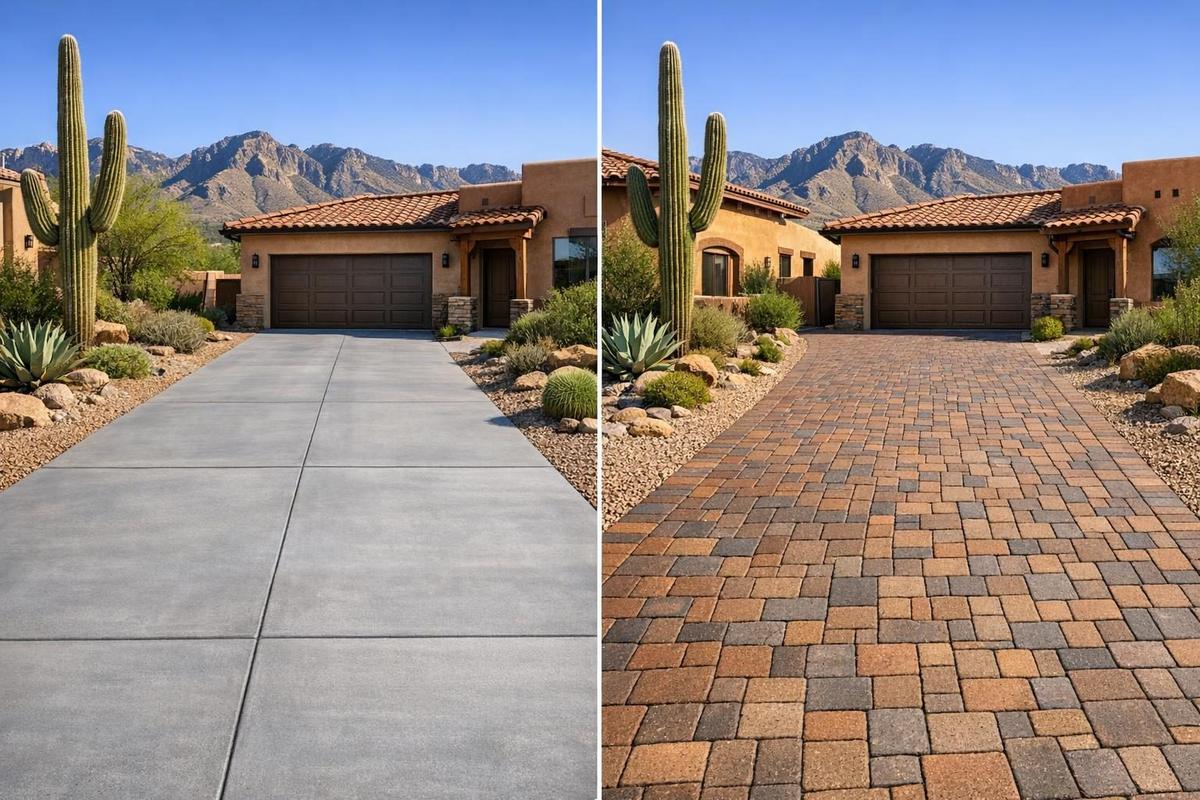
A poured slab typically runs $6 to $12 per square foot installed, depending on thickness and site prep. Interlocking block installations start around $12 and can reach $25 or more per square foot. That gap widens on larger projects because slab work scales efficiently while block layouts require individual hand placement.
For a typical two-car layout (400 to 600 square feet), expect to pay roughly $2,400 to $7,200 for a poured slab and $4,800 to $15,000 for blocks. The difference comes from lower material cost per unit area, fewer labor hours for a continuous pour, and no extra bedding sand layer. Check current Tucson pricing because material costs shift with fuel and supply chain conditions.
Durability and Lifespan in Arizona Heat
A properly poured and cured slab lasts 25 to 30 years in Tucson when it’s finished at the right thickness and reinforced with rebar or fiber mesh. Block surfaces can last 25 to 50 years because individual units flex slightly under thermal expansion rather than cracking across a large surface. That flexibility is a real advantage when summer ground temps hit 150 degrees Fahrenheit.
Slabs develop hairline cracks over time. Most are cosmetic, but structural cracks from poor subgrade compaction require cutting out and replacing an entire section. Blocks handle this better. If one or two pieces crack or settle, you pull them out and drop in replacements. The catch: you need to keep matching spares on hand because manufacturers discontinue colors and profiles regularly.
Maintenance Requirements
Slab surfaces need sealing every 2 to 3 years to resist staining from oil, tire marks, and monsoon mineral deposits. A quality acrylic or penetrating sealer costs about $0.15 to $0.25 per square foot if you do it yourself. Beyond sealing, periodic pressure washing keeps the surface clean. That’s about it for routine care. Read our full guide on maintaining a slab surface for step-by-step instructions.
Block systems demand more attention. Polymeric sand between joints washes out during heavy monsoon storms and needs topping off once or twice a year. Weeds push through gaps where sand has eroded. You’ll also reseal the surface every 2 to 3 years, plus occasionally re-level any pieces that shift on the bedding layer.
Design Options and Curb Appeal
Plain gray slabs look utilitarian. Stamped patterns, integral color, acid staining, and exposed aggregate finishes transform that blank canvas into something that mimics flagstone, brick, or natural tile. Browse design ideas for slab finishes to see what’s possible with decorative techniques.
Blocks win on variety out of the box. Manufacturers offer dozens of shapes, colors, and textures you can mix without special finishing skills. For homeowners who want a complex, multi-tone look, interlocking units deliver that without custom tooling.
Both options add value to a property. Real estate appraisers in Tucson note that a well-maintained poured surface or a block layout both improve curb appeal over gravel or bare dirt, which is still common on older lots.
Which Material Works Best for Tucson Homes?
Pick a poured slab if your budget is tight and you prefer low ongoing effort. Pick interlocking blocks if you’re willing to spend more upfront for easier spot repairs and a wider range of visual styles. Soil conditions matter too. The expansive clay common in midtown and east Tucson causes more movement than rocky caliche near the foothills, and block systems handle that flex better than large slabs.
One thing I see homeowners overlook: drainage grading. Neither material performs well if water pools against it. Make sure your installer grades the surface at a minimum 1% slope away from the garage and toward the street or a retention basin.
Start by measuring your total square footage and getting quotes for both options. Then weigh upfront cost against the long-term maintenance budget you’re comfortable with. If you’re in Tucson and want an honest recommendation for your specific lot, contact our team for a free on-site estimate on a concrete driveway versus pavers.
Frequently Asked Questions About Concrete Driveway Versus Pavers
Is a poured slab cheaper than interlocking blocks?
Yes. A poured surface costs $6 to $12 per square foot installed, while block systems run $12 to $25 or more. The gap grows on larger projects because slab installation scales more efficiently than hand-set layouts.
How long does each surface last in Tucson’s climate?
A reinforced slab lasts 25 to 30 years with proper sealing and subgrade preparation. Block surfaces can last 25 to 50 years because individual units flex under thermal stress instead of cracking across a wide area.
Can I repair cracks without replacing the whole surface?
Block layouts allow spot repairs by pulling and replacing individual units. Slab repairs are more involved because you often need to saw-cut and remove an entire section, then pour a new one to match.
Which option handles Tucson monsoon drainage better?
Permeable block systems allow water to seep through joints, reducing runoff. Solid slabs shed water quickly, which is fine if grading directs flow away from your foundation. Both work well when installed with a 1% minimum slope.
Do interlocking blocks increase home resale value more than a slab?
Both materials boost curb appeal over gravel or bare dirt. Appraisers focus more on condition and design quality than material type. A well-maintained stamped slab can appraise as favorably as a block layout in most Tucson neighborhoods.