
Concrete driveway thickness determines how long your slab lasts and how much weight it handles. In Tucson, where soil conditions and extreme heat both affect performance, getting the right depth matters more than most homeowners realize. Four inches is the standard minimum, but that changes based on what you park, what soil sits underneath, and how well the sub-base is prepared.
Standard Concrete Driveway Thickness for Homes
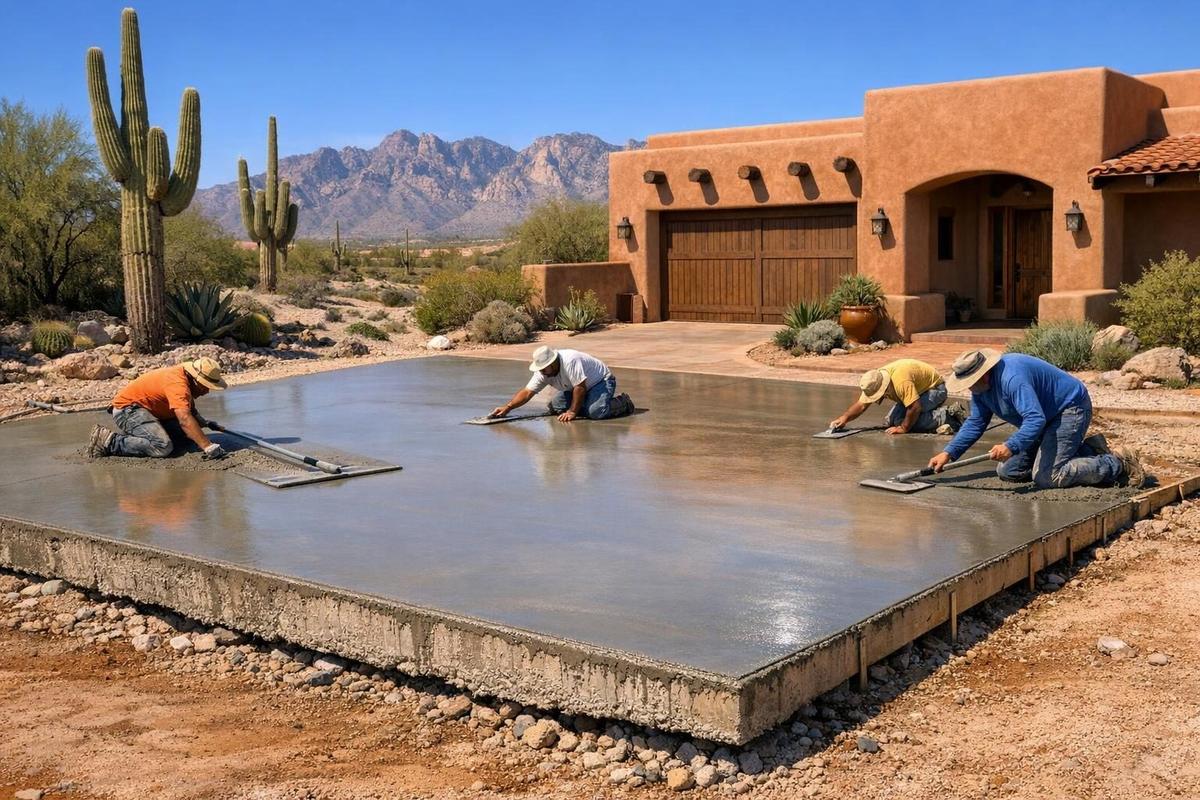
A residential slab should be at least 4 inches thick. That baseline comes from the American Concrete Institute (ACI), the organization that sets structural standards for placement and curing. At 4 inches, a properly mixed slab handles sedans, SUVs, and light trucks without cracking.
Most Tucson homes fall into this category. If you park passenger vehicles and the occasional pickup, 4 inches of 3,000 to 4,000 PSI mix on compacted ground does the job. Go thinner and you risk failures within two years.
The sub-base matters as much as the slab. Tucson’s native caliche compacts well, but pockets of loose fill need extra preparation. A 4-inch pour on poorly compacted ground performs worse than a thinner slab on solid, graded soil. Always verify compaction before the pour.
When You Need 5 to 6 Inches of Depth
Go thicker if your situation involves any of the following:
- RVs, trailers, or boats parked on the surface regularly
- Commercial delivery trucks accessing the property
- Vehicles over 8,000 pounds gross weight
- Expansive or poorly draining soil at the pour site
A 6-inch slab with welded wire reinforcement supports loads up to 10,000 pounds. Thicker pours also resist thermal cracking better in our climate, where surface temps can exceed 150 degrees in summer. If you’re weighing your options, our comparison of asphalt versus concrete covers the long-term cost differences.
Does Rebar Make a Difference?
Rebar doesn’t change the pour depth, but it changes how the slab performs under stress. Steel holds cracked sections together so they don’t shift or separate. For a 4-inch residential pour, #3 rebar on 18-inch centers or 6×6 wire mesh is standard.
Skip rebar on well-compacted caliche supporting only light vehicles. Add it when soil is questionable, spans exceed 10 feet without a control joint, or heavy loads are expected. The cost is roughly $0.50 to $1.00 per square foot, small compared to replacing a failed slab. For pricing details, see our Tucson concrete prices page.
Choosing the Right PSI Rating
PSI measures compressive strength after the 28-day curing period. Here are common options for Tucson pours:
| PSI Rating | Best For | Cost vs. Baseline |
|---|---|---|
| 2,500 PSI | Sidewalks, light foot traffic | Baseline |
| 3,000 PSI | Standard residential slabs | +5-10% |
| 4,000 PSI | Heavy residential, light commercial | +15-20% |
Most residential pours here use 3,000 to 4,000 PSI. A higher cement-to-water ratio produces stronger results but makes the mix harder to work, so placement and finishing need to happen fast. In Tucson’s heat, rapid moisture loss during curing is the biggest threat. Wet curing or a curing compound is non-negotiable.
How Much Weight Can a 4-Inch Slab Hold?
At 3,000 PSI on compacted soil, a 4-inch slab supports about 6,000 pounds of static load. That covers most passenger vehicles. A Ford F-150 weighs roughly 4,500 pounds. A fully loaded Suburban tops 7,500, which pushes the limits of a standard 4-inch pour.
If you regularly park anything over 6,000 pounds, stepping up to 5 inches provides a real safety margin. The material cost difference runs 20 to 25 percent, but the lifespan improvement often doubles the slab’s useful years. The benefits of a strong slab extend well beyond parking.
Sub-Base Preparation in Tucson Soil
Most failures start here. Tucson’s caliche provides excellent bearing capacity when undisturbed. Problems arise when that layer gets excavated, filled, or mixed with topsoil during grading. Proper prep follows these steps:
- Excavate to uniform depth for the slab plus a 2 to 4 inch gravel base.
- Remove organic material, loose fill, and debris.
- Compact with a plate compactor to at least 95% Proctor density.
- Spread and compact gravel, then verify slope for drainage (minimum 1% away from structures).
Skipping compaction is the most common cause of premature cracking in Tucson. The pour takes hours. Prep takes a full day. Any contractor rushing through grading is cutting corners. For long-term care after installation, our guide on maintaining your surface covers sealing schedules and crack repair.
Start by checking your heaviest vehicle’s weight and talking to a local contractor about soil conditions at your site. Then decide between a 4-inch standard pour and a 5 or 6-inch heavy-duty option based on actual loads. Choosing the right concrete driveway thickness now saves thousands in replacement costs later. If you’re in Tucson, call us for a free written quote and driveway recommendations tailored to your property.
Frequently Asked Questions
What is the minimum depth for a residential slab?
The minimum is 4 inches for residential use supporting passenger vehicles. This provides adequate compressive strength with a 3,000 PSI mix and compacted sub-base. Anything less risks cracking under normal loads within a few years.
Is 2 inches enough for vehicle traffic?
No. A 2-inch pour cracks under the weight of a standard car. It lacks the structural capacity to distribute loads regardless of mix strength. Four inches is the absolute floor.
Should I use rebar or wire mesh?
Wire mesh works for standard 4-inch pours on stable soil. Rebar is better for 5-inch or thicker slabs, spans over 10 feet, or unstable ground. Both prevent cracked sections from separating over time.
How long does a properly poured slab last in Tucson?
A 4-inch slab at 3,000 to 4,000 PSI with proper preparation typically lasts 25 to 30 years here. Sealing every 2 to 3 years and fixing cracks early extends that further. Heat and UV are the main wear factors in southern Arizona.
What PSI should I choose?
Use 3,000 PSI for light-duty residential use and 4,000 PSI for heavier vehicles or extra durability. The cost gap is modest compared to the strength gain.