
Choosing between asphalt and concrete for a new driveway in Tucson comes down to upfront price, long-term durability, and how each surface handles triple-digit heat. The driveway cost for asphalt versus concrete typically ranges from $3 to $6 per square foot for the dark-paved option and $5 to $10 per square foot for a cement-based slab, though local labor rates, soil prep, and thickness all shift those numbers. For a standard two-car pad of about 600 square feet, that translates to roughly $1,800 to $3,600 or $3,000 to $6,000 depending on your choice. Below, we break down exactly where each dollar goes and why one material often wins on total lifetime value in the desert Southwest.
- Upfront Installation Costs: Asphalt vs. Concrete Driveways
- Long-Term Maintenance and Repair Expenses
- Durability and Lifespan in Tucson's Desert Climate
- Heat Performance: Which Surface Gets Hotter?
- Safety, Appearance, and Home Value
- How to Decide: Asphalt or Concrete for Your Tucson Home
- Frequently Asked Questions About Driveway Cost: Asphalt Versus Concrete
Upfront Installation Costs: Asphalt vs. Concrete Driveways
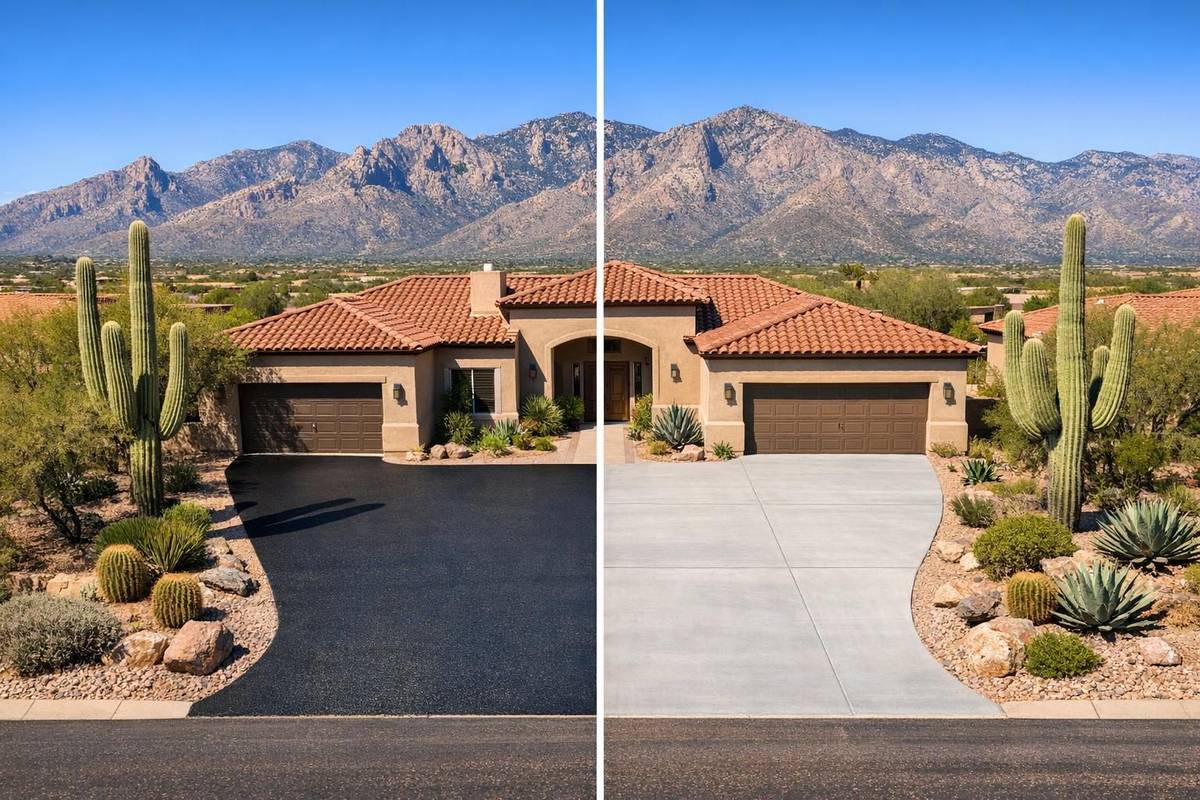
Asphalt is a hot-mix material made primarily from petroleum-based bitumen and aggregate. Because bitumen is a byproduct of crude oil refining, prices for this paving option fluctuate with oil markets. A typical residential install in Tucson runs $3 to $6 per square foot, including grading, base layer, and rolling.
Concrete is a blend of Portland cement, water, sand, and gravel that cures into a rigid slab. Installation sits higher at $5 to $10 per square foot because the pour process takes more time, skilled labor, and cure time before the surface can handle traffic. The recommended thickness for a residential slab is 4 to 5 inches, which adds material expense compared to the 2- to 3-inch layer most contractors pour for the hot-mix alternative.
| Factor | Hot-Mix (Asphalt) | Cement Slab |
|---|---|---|
| Material cost per sq ft | $2 to $4 | $3 to $7 |
| Labor cost per sq ft | $1 to $2 | $2 to $3 |
| Total installed cost (600 sq ft) | $1,800 to $3,600 | $3,000 to $6,000 |
| Typical thickness | 2 to 3 inches | 4 to 5 inches |
| Cure/ready time | 1 to 2 days | 7 days minimum |
One thing most guides skip: grading and base prep can add $1 to $3 per square foot regardless of surface material. Tucson’s caliche soil layer often requires excavation before either material can be placed, so get a site evaluation before comparing bids.
Long-Term Maintenance and Repair Expenses
Upfront price only tells half the story. The hot-mix option requires seal-coating every 3 to 5 years at roughly $0.15 to $0.25 per square foot. Skip that step, and UV exposure will oxidize the binder, turning the surface brittle. Crack filling runs another $100 to $300 per visit depending on severity. Over a 20-year span, maintenance on a paved surface can add $2,000 to $4,000 to the original investment.
A cement-based slab needs far less routine work. Periodic pressure washing and an optional penetrating sealer every 5 to 7 years keep things looking new. Cracks in a poured slab are less common but more expensive to fix, sometimes $300 to $600 per repair, because patching requires color matching and bonding agents. Still, total maintenance over 20 years typically stays under $1,500 for a well-installed surface.
In my experience working on driveways across southern Arizona, the maintenance gap is where concrete pulls ahead. Homeowners who choose asphalt to save money upfront often spend more within the first decade on seal coats and patches than the price difference at install.
Durability and Lifespan in Tucson’s Desert Climate
A properly installed slab lasts 30 to 50 years. A hot-mix surface lasts 15 to 20 years with consistent seal-coating. That difference matters when you calculate the per-year price of each material.
Tucson’s intense sun accelerates asphalt degradation. UV radiation breaks down the petroleum binder, and summer surface temperatures on dark pavement can exceed 150 degrees Fahrenheit, a phenomenon researchers call the urban heat island effect. A cement-based surface reflects more sunlight and stays 20 to 30 degrees cooler, reducing thermal stress on the slab and on anything parked on it.
Freeze-thaw cycles rarely threaten either material here, which is one advantage of building in the Sonoran Desert. In colder states, water seeping into porous pavement and expanding during freezes is the number-one cause of pothole formation. Tucson homeowners don’t face that problem, but they do face monsoon flooding. Concrete handles standing water better because its rigid structure resists soft-spot formation that plagues hot-mix surfaces after heavy rain saturation.
Heat Performance: Which Surface Gets Hotter?
Dark pavement absorbs significantly more solar energy than a lighter slab because of its color. On a typical July afternoon in Tucson, an asphalt surface can reach 150 to 160 degrees Fahrenheit while a cement-based pad stays closer to 120 to 130 degrees. That 30-degree gap makes a real difference if you walk barefoot to grab the mail or if your dog crosses it.
Lighter-colored slabs also reduce ambient air temperature around the home, which can shave a small amount off cooling bills. The Portland Cement Association, the industry group representing cement manufacturers, has published data showing that reflective pavement surfaces contribute less to localized heat buildup in residential areas. For a city that averages over 100 days above 100 degrees, that thermal advantage adds up.
Safety, Appearance, and Home Value
A poured slab offers a smoother, more uniform surface that reduces trip hazards. It also accepts decorative finishes (stamped patterns, exposed aggregate, colored stains) that let you match the look of your home. Check out these concrete design tips for driveways if you want something beyond a standard gray pour.
The hot-mix alternative gives you one look: flat black. It softens in extreme heat, which can leave tire impressions if a vehicle sits in the same spot for days during summer. A cement slab stays rigid regardless of temperature.
From a resale standpoint, a well-maintained poured surface can increase home value by 5% to 10% of the project cost. Appraisers and buyers in Tucson recognize the longevity difference, especially when comparing a home with a cracked dark pad to one with an intact slab. The benefits of choosing concrete for your driveway extend well beyond curb appeal.
How to Decide: Asphalt or Concrete for Your Tucson Home
Budget is the most common deciding factor. If your total budget sits below $2,500 for a standard two-car pad, the hot-mix route may be your only realistic option. Above that threshold, a poured slab becomes competitive once you factor in lower maintenance and longer lifespan.
Ask yourself three questions before requesting quotes:
- How long do you plan to stay in the home? If fewer than 10 years, the lower entry price of asphalt makes sense. Beyond that, a slab’s durability pays for itself.
- Do you care about appearance? Concrete supports stamped finishes, borders, and color. The dark-paved option does not.
- Will heavy vehicles (RVs, trailers, work trucks) use the surface regularly? A rigid slab handles sustained heavy loads without deforming. Hot-mix pavement may rut under parked weight in summer heat.
For current material pricing in the Tucson metro area, see our Tucson concrete price guide.
Start by getting at least three quotes from local contractors who install both materials. Compare the bids not just on install price but on projected 10-year and 20-year total expense. If the numbers are close, a poured slab almost always wins on lifetime value for Tucson homeowners evaluating driveway cost for asphalt versus concrete. Call us for a free estimate, and we’ll walk through the comparison with real numbers for your property and help you pick the right driveway solution.
Frequently Asked Questions About Driveway Cost: Asphalt Versus Concrete
How much does a concrete driveway cost compared to asphalt in Tucson?
A poured slab for a standard 600-square-foot, two-car pad runs $3,000 to $6,000 installed. A hot-mix surface for the same area runs $1,800 to $3,600. However, lower maintenance needs and a 30- to 50-year lifespan often make the cement option cheaper per year of service.
Does asphalt crack more than a poured slab in hot climates?
Yes. Hot-mix pavement softens and oxidizes faster under intense UV exposure. In Tucson, where summer surface temps reach 150 degrees or higher, it develops cracks and surface wear within 5 to 8 years without regular seal-coating. A cement slab resists UV degradation and holds its structure longer in extreme heat.
Can you pour a new slab over an existing asphalt pad?
Technically yes, but it’s rarely recommended. The old base can shift and settle unevenly, causing the overlay to crack. Most contractors advise removing the existing pavement entirely, regrading the base, and pouring fresh for best results.
Is a poured slab or hot-mix surface better for resale value?
A cement-based pad adds more to a home’s appraised value. Real estate professionals in the Tucson market note that buyers perceive it as a longer-lasting, lower-maintenance option. A well-maintained slab signals quality construction and reduces buyer concerns about near-term replacement costs.
How long before you can drive on a new surface?
You can drive on new hot-mix pavement within 1 to 2 days. A poured slab requires at least 7 days of curing before vehicle traffic, and full strength develops over 28 days. Plan accordingly if you only have one driveway and need daily vehicle access during the project.